By Dan Joffe, lawyer at NextLaw (LSO #37145V) · Published October 2, 2026 · Last updated October 2, 2026 · Ontario, Canada
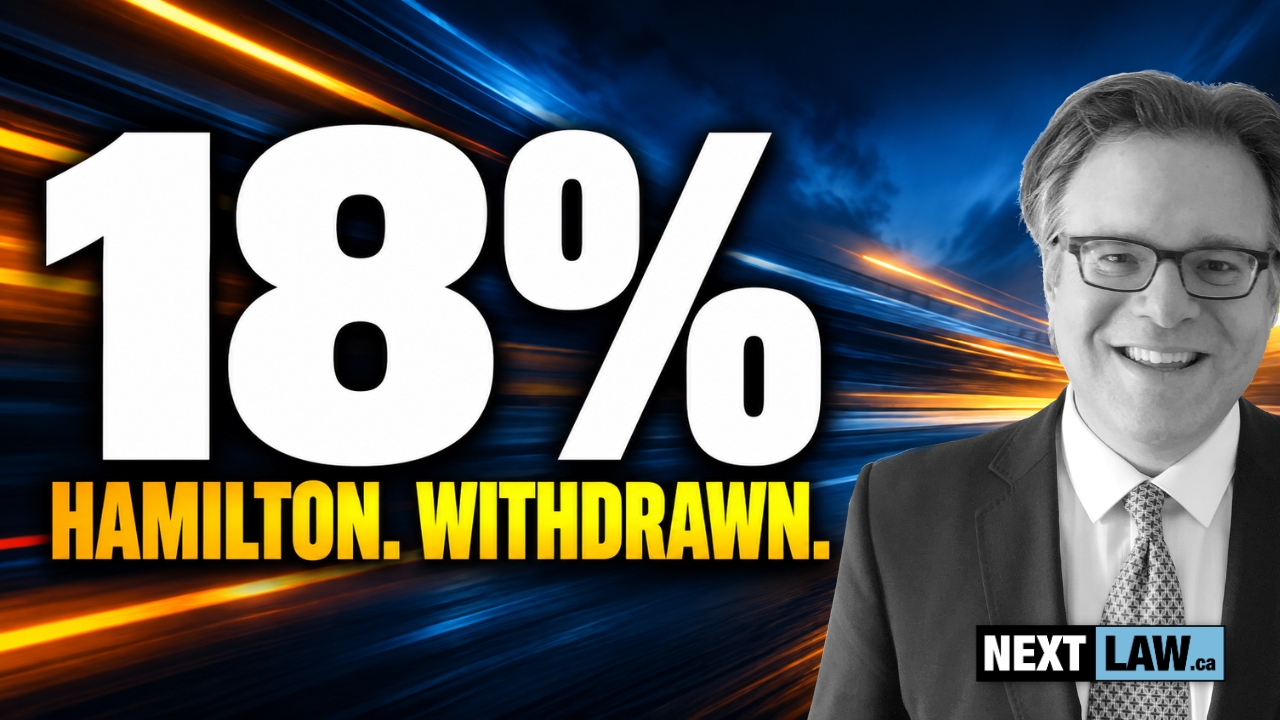
Short answer: Looking for a traffic ticket lawyer in Hamilton, Ontario? Here's what Hamilton's court does with speeding charges: it withdraws fewer of them than the rest of Ontario. According to NextLaw Analysis of Ontario Court of Justice data, since 2023, 18% of Hamilton speeding charges reaching a trial date were withdrawn that day, against 27% across Ontario. Before speed cameras, from 2015 to 2019, it was 10% against 22%. So a traffic ticket lawyer in Hamilton is hired to negotiate a better outcome, not to wait for the case to fall apart. The data can't predict your insurance, but it shows what a lawyer here is really hired to do.
https://youtu.be/EugPpJt7vjs
Traffic ticket lawyer Hamilton: fewer charges get withdrawn
In both periods, fewer Hamilton speeding charges were withdrawn on the trial date than across Ontario: 10% vs 22% in 2015–2019 and 18% vs 27% in 2023–March 2026. Source: NextLaw Analysis of Ontario Court of Justice, Provincial Offences Court Statistics.
We analyzed eleven years of Ontario Court of Justice data, 2015 through March 2026, for speeding charges under Ontario's Highway Traffic Act (section 128), what most people call a speeding ticket. We looked at one measure in particular: of the Hamilton speeding charges that reach a trial date, how many are withdrawn on that day.
In Hamilton, fewer speeding charges get withdrawn than across Ontario. Since 2023, 18% of Hamilton charges reaching a trial date were withdrawn that day, against 27% province-wide. It's not new. Before speed cameras, from 2015 to 2019, Hamilton's trial-date withdrawal rate was 10%, against 22% for Ontario, and it was lower in every one of those years: Hamilton ran between 9% and 12% a year, Ontario between 19% and 24%.
Speeding charges withdrawn on the trial dateHamiltonOntario2015 to 2019 (before speed cameras)10%22%2023 to March 202618%27%Share of speeding charges (Highway Traffic Act s.128) reaching a trial date that were withdrawn that day, pooled over each period. In 2015–2019 Hamilton's yearly rate stayed between 9% and 12%, against 19% to 24% for Ontario. The reason for a withdrawal is not recorded. Source: Ontario Court of Justice, Provincial Offences Court Statistics (2015–2019; 2023–March 2026); NextLaw Analysis.
Source: Ontario Court of Justice, Provincial Offences Court Statistics (2015–March 2026); analysis by NextLaw.
What happens to Hamilton speeding charges on the trial date
About half of Hamilton speeding charges reaching a trial date in 2023–March 2026 ended in a guilty plea on the day (49%, against 42% across Ontario), and fewer were withdrawn (18% against 27%). Source: NextLaw Analysis of Ontario Court of Justice, Provincial Offences Court Statistics.
According to NextLaw Analysis of the same data, since 2023, 49% of Hamilton charges reaching a trial date ended in a guilty plea on the day, against 42% across Ontario. 22% ended in a conviction because the defendant didn't show up (21% across Ontario). And 11% went to a full trial (10% across Ontario). With the 18% withdrawn, that covers all 1,494 Hamilton speeding charges that reached a trial date from 2023 to March 2026.
How the charge ended on the trial date (2023 to March 2026)HamiltonOntarioGuilty plea on the day49%42%Convicted because the defendant did not attend22%21%Withdrawn on the day18%27%Full trial held11%10%Share of speeding charges (Highway Traffic Act s.128) that reached a trial date; each column sums to 100%. A guilty plea on the day can be a plea to a lower speed, so it is not a loss rate. Trial verdicts are not recorded. The no-show figure is the one most exposed to camera-era trial requests from vehicle owners. Source: Ontario Court of Justice, Provincial Offences Court Statistics (2023–March 2026); NextLaw Analysis.
A plea on the day can be to a lower speed, so these figures describe how cases end, not who lost.
What the Hamilton data can't tell you
The data can't tell us why a charge was withdrawn, who won at trial, or how many pleas were to a lower speed. It counts charges, not drivers. It describes the court, not your odds.
What you're hiring a Hamilton traffic ticket lawyer for
Our read at NextLaw is this: when two separate periods show the same pattern, it reflects how this court consistently works, not an anomaly. A speeding charge rests on the officer's evidence, and Hamilton's low withdrawal rate suggests that evidence is usually there on the trial date. So the realistic goal here is a better deal, such as a plea to a lower speed.
That's what you're hiring a Hamilton lawyer for. A lawyer gets the disclosure, the prosecution's evidence against you, and checks it for mistakes in:
- how your speed was measured,
- the officer's notes, and
- the ticket itself.
Any mistake becomes leverage for a better deal, and sometimes for a withdrawal. A lawyer or paralegal can also appear for you (Provincial Offences Act, section 84; Ontario Court of Justice, Guide for Defendants in Provincial Offences Cases), so you don't lose the case by missing the date. If you are deciding between the two, our guide on whether you need a lawyer or a paralegal for a speeding ticket in Ontario sets out the difference.
★★★★★
They got me a great deal given my circumstances, which were not great. They went to court for me, were very communicative, and proactively set up calls.
— Aaron H., verified 5-star Google review
The same job looks different in other courts. In Brampton, the pattern runs the other way: most speeding charges that reach a trial date are withdrawn on the day (see our Brampton court data). That's why the court matters when you hire.
Your first 15 days with a Hamilton speeding ticket
You have fifteen days from the ticket to choose one of three options (Provincial Offences Act, section 5):
- Pay it. Paying is a guilty plea, and the conviction goes on your record.
- Meet the prosecutor. This is called early resolution.
- Ask for a trial. The case goes to a trial date, where the outcomes above apply.
Ignoring the ticket ends in the same conviction as paying (Provincial Offences Act, section 9). For what paying means in Hamilton, and how long the court takes if you fight, see our Hamilton court data on speeding tickets.
Got a speeding ticket in Ontario? Don't pay it yet. Not every ticket is worth fighting. But every ticket is worth checking. Our free insurance calculator asks 7 quick questions to see how much your insurance could go up. Get your number first. Then, if it makes sense, book a free call for a straight answer.
How the camera years were handled
Speed cameras operated in Ontario from July 2020 until they were banned on November 14, 2025 (Bill 56). Camera tickets were issued to the vehicle owner, carried no demerit points and never touched a driving record. Because they distorted how many tickets were issued and how many were simply paid, this analysis uses the five camera-free years, 2015 to 2019, for those measures, confirmed against the first post-ban months of 2026. It uses the most recent three years only for what happens on the day of trial, where camera tickets almost never reached.
A check on that: 1,494 Hamilton speeding charges reached a trial date from 2023 to March 2026, 1.2 times the pre-camera size of Hamilton's trial docket (Ontario: 63,135 charges, 0.8 times). Camera tickets did not swamp the trial docket. Every figure on this page covers Highway Traffic Act section 128 speeding charges only.
Quick answers
Is it worth fighting a reduced speeding ticket in Ontario?
It can be. Paying a reduced ticket is still a guilty plea. A plea to a lower speed can reduce or remove demerit points, but it doesn't erase the conviction, which stays on your driver's record for three years from the conviction date. The insurance effect depends on the tier crossed and your insurer's rules; our guide to how a speeding ticket could affect your insurance in Ontario covers the insurance side.
What is the best defense against a speeding ticket?
It starts with the officer's evidence, including how your speed was measured. In Hamilton, you can request disclosure once you have a court date, using the Disclosure Request Form for the Municipal Prosecutor's Office, and the city posts the manuals for the radar and laser devices Hamilton Police and the OPP use (City of Hamilton, Provincial Offences Notice). No outcome is guaranteed. Our guide on how to fight a speeding ticket in Ontario walks through the steps.
About NextLaw
NextLaw is a speeding ticket law firm based in Toronto, representing drivers in every court in Ontario, including Hamilton. This article was written by Dan Joffe, lawyer at NextLaw (Law Society of Ontario #37145V). For speeding ticket inquiries, call 647-558-2679. Court statistics current as of March 2026; this is general information about Ontario law, not legal advice about your specific case. https://www.nextlaw.ca/?p=36309
Comments
Post a Comment