Written by Jon Cohen, Partner at NextLaw — a speeding ticket law firm based in Toronto, representing drivers in every court in Ontario.
Published August 13, 2026 · Last updated August 13, 2026 · Current as of the Ontario Court of Justice set-fine schedule in effect in 2026.
A speeding ticket in Ontario is a set fine that scales with how far over the limit you were — roughly $2.50 to $6.00 for every kilometre over. A typical 15-over ticket works out to about $52.50 all-in, and the most recent Ontario Court of Justice data puts the average speeding fine ordered at about $148. But the fine is the small part. A conviction can sit on the record insurers price from for years — and that could be the number that dwarfs the ticket. This guide breaks down the true cost of an Ontario speeding ticket: fine, demerit points, and insurance, plus one wrinkle almost every page online gets wrong.
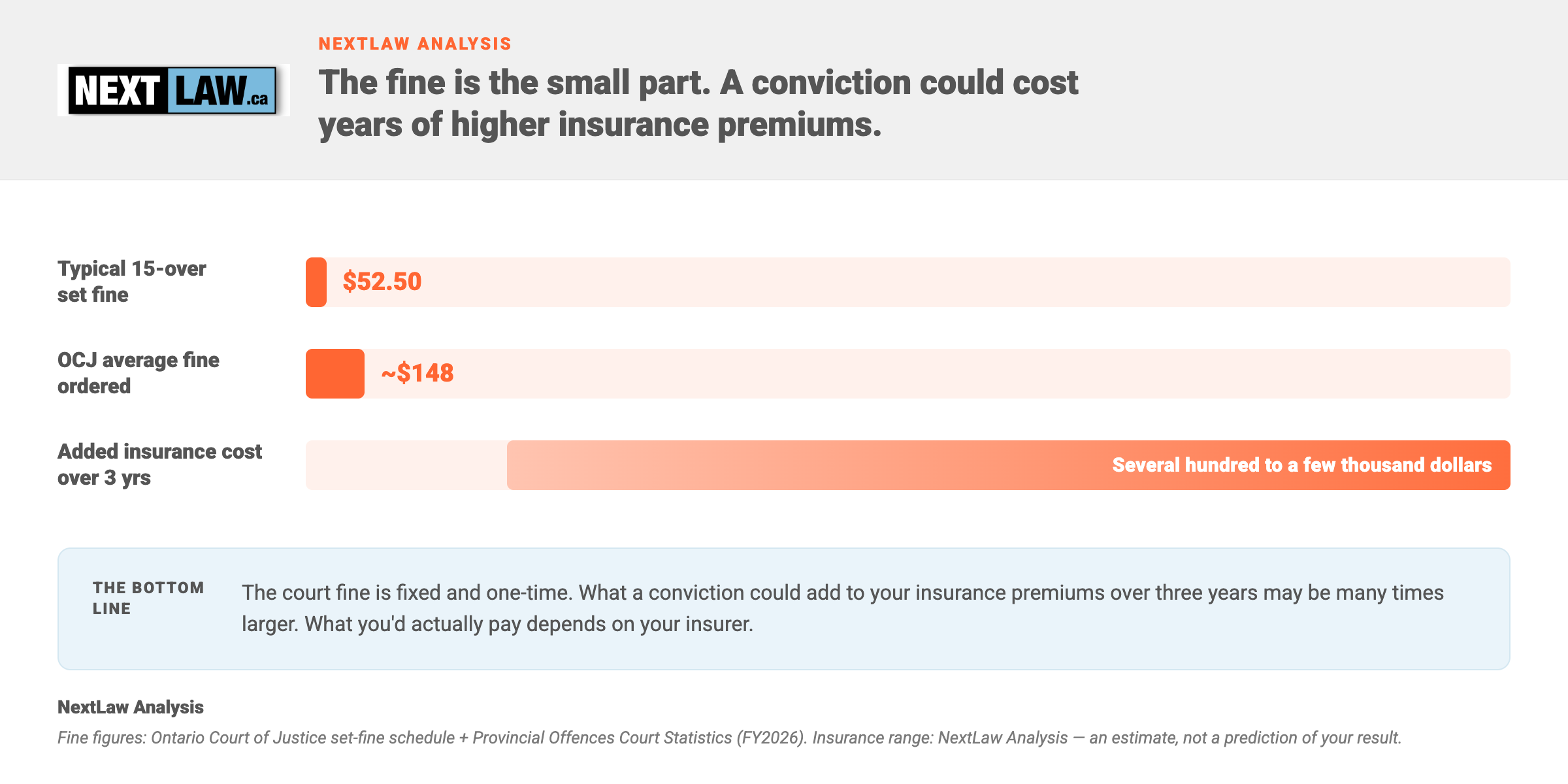
The $52.50 fine is the small part: an Ontario speeding conviction could add far more in insurance over three years than it costs at court. Source: NextLaw Analysis of Ontario court and insurance data.
https://youtu.be/PBaqJWAc5Hw
How much is a 15 over speeding ticket in Ontario?
A 15-over speeding ticket in Ontario is about $52.50, with zero demerit points. Here is how that breaks down. On a Part I ticket — the standard speeding ticket — the amount you can pay out of court is called the set fine, and for speeding it runs on a per-kilometre scale set by the Ontario Court of Justice set-fine schedule: about $2.50 a kilometre for 1 to 19 over, $3.75 for 20 to 29 over, and $6.00 a kilometre for 30 to 49 over.
So 15 kilometres over the limit is 15 × $2.50 = $37.50, plus a $10 victim fine surcharge under O. Reg. 161/00 and $5 in court costs under R.R.O. 1990, Reg. 945. That is $52.50 all-in — and at 15 over, no demerit points.
A 15-over speeding ticket in Ontario is $52.50 all-in — a $37.50 set fine plus a $10 victim surcharge and $5 court costs, at zero demerit points. Source: NextLaw Analysis.
Why the government's numbers look higher — the two fine schedules
Here is where almost every website gets it wrong. The Ontario government's own page lists higher per-kilometre numbers — $3.00, $4.50, $7.00. Those are the Highway Traffic Act figures: the maximum a court can impose. The number on your ticket that you can simply pay is usually the lower set fine. Same offence, two different fine schedules — and knowing which one applies is exactly what trips people up.
Speed over the limitSet fine — what you pay out of court (per km)Highway Traffic Act figure — the court maximum (per km)Demerit points1–19 km/h over$2.50$3.000 (at 15 over)20–29 km/h over$3.75$4.50330–49 km/h over$6.00$7.004Add a $10 victim fine surcharge and $5 in court costs to the set-fine total. Sources: Ontario Court of Justice set-fine schedule; Highway Traffic Act s. 128; O. Reg. 161/00; R.R.O. 1990, Reg. 945.
Two fine schedules exist for the same speeding offence: the lower set fine ($2.50–$6.00/km) is what most drivers pay out of court, while the higher Highway Traffic Act figure is only the court maximum. Source: NextLaw Analysis.
Even the right number is the small part. If you are looking this up, you probably already sense the real cost is not the fine — it is your insurance. A G2 driver we represented knew that too when he walked in. What he did not know was how big that number could get — and what could still be done about it.
How many points is 70 in a 50?
Seventy in a fifty is 20 kilometres over the limit, which is 3 demerit points under the demerit point system (O. Reg. 339/94), with a set fine of 20 × $3.75 — about $95 all-in. But for most drivers, the points are not the real cost. They fade after two years, and you would need to stack up a lot of them to lose your licence. Insurance is the real cost.
A speeding conviction can sit on the record insurers price from for years, and it could cost far more than the ticket. Independent modelling from Ratehub puts a single minor conviction at close to $1,000 in added premiums over three years. Our own read — what we call NextLaw Analysis — is that a conviction like this could cost anywhere from several hundred to a few thousand dollars over three years — could being the operative word, because every insurer prices it differently, and the range moves with the offence tier:
Conviction tierNextLaw estimate — added insurance cost over 3 yearsZero-point conviction (e.g. 15 over)roughly $510–$1,200Multi-point conviction (e.g. 20 over / 3 points)roughly $1,785–$4,335NextLaw Analysis; ranges, not a quote for your policy. What a conviction could actually cost depends on your insurer's own rules. This is an estimate, not a prediction of your result.
A speeding conviction's insurance cost is the part that lingers: a zero-point conviction could add roughly $510–$1,200 over three years, a multi-point one roughly $1,785–$4,335. Ranges, not a quote. Source: NextLaw Analysis.
Take that same G2 driver we represented. He already had one speeding ticket that had pushed his insurance up hard — and this was his second. For a G2 driver, a second speeding conviction can start to look like a pattern, and a pattern is what could push someone toward high-risk pricing, or toward worrying about becoming uninsurable. That was the fear he walked in with. For him, the number on the ticket was never the number that mattered.
Is it worth fighting a speeding ticket in Ontario?
Often, yes — but not for the reason people expect. It is usually worth it not to win a dramatic courtroom dismissal, but to get the charge reduced to a lower or non-speeding offence that protects your record and your insurance. With that same G2 driver, we used a strategy we call tiered mitigation. Picture a ladder, with his speeding charge sitting right at the top. Every time we move it down a rung, it improves three things at once: his demerit points, his driving record, and his insurance.
- Rung 1 — drop the speed into a lower band. Get it under 30 kilometres over the limit and it becomes what insurance treats as a minor charge.
- Rung 2 — get to 15 over. At 15 over you are at zero demerit points.
- Rung 3 — turn it into "disobey a sign." This is the rung we really wanted for him, because he was a G2 with a ticket already. Disobey a sign is not a speeding offence at all — to an insurer it is a non-moving violation, so his record does not show speeding, and they do not see a pattern of speeding building up. Generally that could be a much better place to be for your insurance — though we always say could, because no one can promise what a specific insurer does.
- Off the ladder entirely — the charge withdrawn. The most recent Ontario Court of Justice data shows about 1 in 9 speeding charges gets withdrawn — the charge dropped, sometimes when there is a problem with the evidence. It happens, but it is never something anyone can promise you.
Fighting a ticket usually means stepping the charge down a ladder — each rung could improve points, record, and insurance — not a dramatic dismissal; a full withdrawal happens in about 1 in 9 cases. Source: NextLaw Analysis.
So here is the realistic version of fighting a ticket: most of the time it is not a withdrawal, it is moving the charge down the ladder to something that protects the record and the insurance sitting behind it. The fine on his ticket was almost beside the point. If you want to see the mechanics of that process in detail, our guide on how to fight a speeding ticket in Ontario walks through it step by step.
Ontario speeding ticket FAQ
What's the best excuse to get out of a speeding ticket?
There isn't one. "I didn't see the sign" or "everyone else was speeding" does not make a ticket disappear. What actually changes your outcome is the charge that ends up on your record — not the story you tell at the roadside.
What happens if you don't pay a speeding ticket in Ontario?
It doesn't go away. The most recent Ontario Court of Justice data shows drivers left about $49 million in speeding fines in default — and default has teeth. Under the Provincial Offences Act, an unpaid fine can block your licence-plate renewal and be referred to collections, on top of the original charge. Ignoring it is the one move that reliably makes things worse.
Ignoring a speeding ticket doesn't make it disappear: drivers left about $49 million in Ontario speeding fines in default in FY2026, and default can block plate renewal and go to collections. Source: NextLaw Analysis.
Source for the court figures above: Ontario Court of Justice, Provincial Offences Court Statistics (FY2026); NextLaw Analysis.
What to do next
Got a speeding ticket in Ontario? Don't pay it yet. Not every ticket is worth fighting — but every ticket is worth checking. Use our free insurance-impact calculator: seven quick questions to see how much your insurance could go up. Get your number first. Then, if it makes sense, book a free call for a straight answer. You can also reach NextLaw at 833-639-8529 or help@nextlaw.ca.
NextLaw represents drivers in speeding and Highway Traffic Act matters in every court in Ontario. This article is general information about Ontario law, not legal advice for your specific case. https://www.nextlaw.ca/2026/08/14/how-much-is-a-speeding-ticket-ontario/
Comments
Post a Comment