Young Drivers and Distracted Driving in Ontario: G1/G2 Complete Guide
If you're a young driver with a G1 or G2 licence in Ontario—or a parent of one—you need to understand that distracted driving penalties for novice drivers are completely different from fully licensed drivers. While an experienced driver might face demerit points, you face something far more serious: immediate licence suspension and potential licence cancellation.
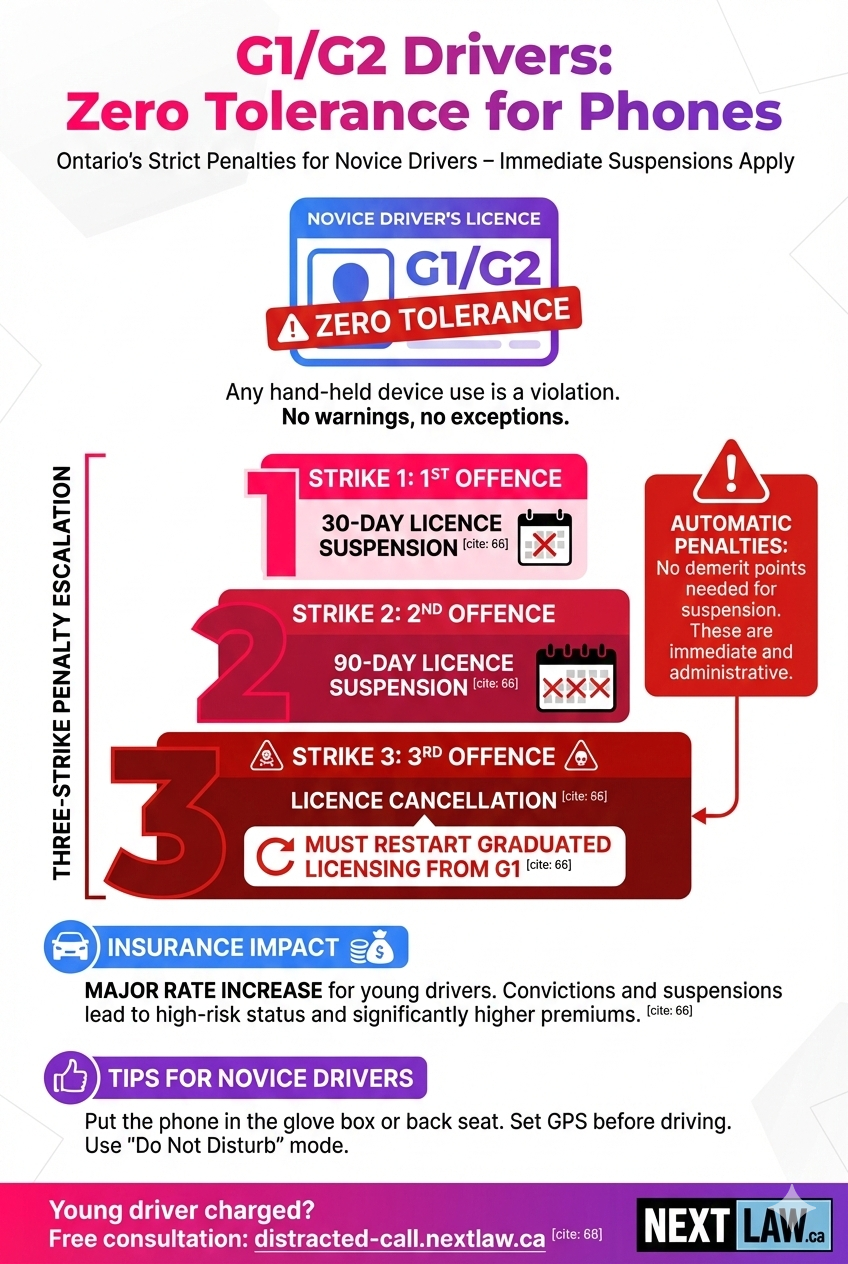
This is not a theoretical concern. In 2025, over 55,086 distracted driving charges were laid in Ontario. A significant proportion of those charges involve young drivers aged 16–25, who have the highest phone-use rates behind the wheel. One distraction—one text message, one glance at your phone—can trigger a 30-day licence suspension on your first offence. A second offence means 90 days without driving. A third means your licence is cancelled and you must restart the entire graduated licensing process from G1.
This guide explains exactly what novice drivers in Ontario need to know about distracted driving laws, penalties, and how to protect yourself if you or someone you care about is charged.
Quick Answer: G1 and G2 drivers who are charged with distracted driving do not receive demerit points. Instead, you face administrative licence suspensions: 30 days for a first offence, 90 days for a second, and licence cancellation for a third—on a 5-year rolling window. These suspensions apply under Highway Traffic Act Section 78.1(7) in addition to any court penalties.
What Is Distracted Driving in Ontario?
Distracted driving in Ontario is defined under Highway Traffic Act Section 78 as using a handheld device while driving. This includes:
- Texting or messaging
- Checking social media
- Reading emails
- Taking photos or videos
- Using a GPS or mapping app while holding the phone
- Using a camera or video recorder
- Watching video content
- Using any electronic device in your hand (with narrow exceptions)
Ontario law permits hands-free use only. You can use a mounted device for GPS navigation if it is secured and the screen is not touched while driving. You can also listen to music through a phone if the device is secured, but you cannot touch it to change songs or adjust volume while driving.
The penalty is immediate—you can be pulled over and charged on the spot.
Novice Driver Penalties: G1/G2/M1/M2 Licence Holders in Ontario
This is where young drivers face a radically different legal outcome than experienced drivers. Ontario law recognizes that novice drivers need stricter consequences, and the system reflects this through administrative penalties under Highway Traffic Act Section 78.1(7).
The Three-Strike System for Novice Drivers
First Offence: 30-day licence suspension (no demerit points)
You lose your driving privileges for one month. Your licence is suspended automatically. You cannot drive during this period, even on private property for practice purposes. You cannot drive for school, work, or emergencies.
Second Offence: 90-day licence suspension (no demerit points)
Your suspension extends to three months. This is a serious disruption—you miss three months of driver experience, three months of driving for work or school, and three months of independence.
Third Offence: Licence cancellation (no demerit points)
Your licence is cancelled entirely. You must restart the graduated licensing process from G1. This means:
- Taking the written knowledge test again
- Passing the G2 road test
- Passing the G full licence road test
- Waiting through all mandatory holding periods (1 year for G1, 1 year for G2)
- Paying all testing and licence renewal fees again
- A minimum of 2 years before you can return to a full G licence (versus months if you had simply finished your original graduated licensing)
The 5-Year Rolling Window
These offences are counted on a 5-year rolling window under Highway Traffic Act Section 78.1(8). This means:
- Your first offence stays on record for 5 years
- If you get a second offence within that 5-year window, the 90-day suspension applies
- If you get a third offence within the 5-year window, your licence is cancelled
- If your second offence occurs more than 5 years after the first, you start the count over at "first offence"
For a young driver, five years might represent 25% of your driving lifetime so far. Any distraction during this window carries severe consequences.
No Demerit Points—But Court Penalties Still Apply
One common misconception is that "no demerit points" means "no penalty." This is false.
The 30/90-day suspensions and licence cancellations are administrative penalties. They are applied automatically by the Ministry of Transportation Ontario when you are convicted of distracted driving. These penalties exist in addition to any court-imposed penalties.
If your case goes to court, a judge may impose additional penalties including:
- A fine (up to $1,000 for first offence, up to $2,000 for subsequent offences)
- Court costs and victim surcharge
- A conviction record
- Possible driver education course requirements
The licence suspension happens regardless. The court fine happens on top of it.
Distracted Driving Penalties in Ontario for Fully Licensed Drivers (G Licence)
For context, here is how fully licensed drivers are treated differently:
- First offence: $490 fine + 4 demerit points
- Second offence: $1,000 fine + 6 demerit points
- Subsequent offence: $2,000 fine + 6 demerit points
A fully licensed driver accumulates demerit points toward licence suspension (15 points triggers a 30-day suspension; 30 points triggers a 6-month suspension). But a novice driver doesn't get points—they get automatic suspension. This is a harsher regime because the suspensions are automatic and immediate, not point-based.
Insurance Impact: The Hidden Cost of a Distracted Driving Conviction
Young drivers already pay the highest insurance premiums in Ontario. A distracted driving conviction will devastate your insurance costs.
Young Driver Base Rates in Ontario
Before any conviction, a young driver can expect to pay:
- Ages 16–19: $4,500–$7,500 per year (depending on vehicle and coverage)
- Ages 20–24: $3,500–$6,000 per year
- Ages 25–29: $2,500–$4,500 per year
These are already the highest rates for any age group in Ontario.
Conviction Surcharge
A major conviction (such as distracted driving) triggers an insurance surcharge of 100–150%. This means:
Base Annual Rate
Surcharge (100%)
Surcharge (150%)
Total With Surcharge
$3,500
$3,500
$5,250
$7,000–$8,750
$5,000
$5,000
$7,500
$10,000–$12,500
$6,000
$6,000
$9,000
$12,000–$15,000
A young driver convicted of distracted driving could pay $12,000–$15,000 per year for insurance. This surcharge typically lasts 3 years from the conviction date.
Why This Matters to Parents
Many parents pay their teen's insurance. If your child is convicted of distracted driving, your family's insurance costs skyrocket. Beyond the direct cost, your insurance company may:
- Remove discounts for good driving records
- Refuse to renew the policy when the term expires
- Place your family with a high-risk insurer (Facility Association rates are significantly higher)
A single moment of distraction becomes a multi-year financial burden on the entire family.
Licence Cancellation: What Restarting G1 Really Means
If you receive a third distracted driving offence and your licence is cancelled, you must restart the graduated licensing system. For a G2 driver, this is especially painful:
Current G2 Restrictions You Lose
A G2 driver has earned the right to drive alone on most roads (with some restrictions on highway speeds and towing). If your licence is cancelled and you restart at G1:
- You can only drive with a qualified supervising driver aged 20+ (with a valid G/G1/M/M1 licence) in the front seat
- Your supervising driver must have held their full licence for at least 4 years
- You cannot drive on most 400-series highways
- You cannot drive between midnight and 5 a.m.
- No towing allowed
- Zero alcohol blood-alcohol concentration (BAC)
Timeline to Get Your Full Licence Back
- G1 to G2: minimum 8 months (with mandatory waiting period), plus passing the G2 road test
- G2 to G: minimum 12 months (with mandatory waiting period), plus passing the G road test
- Total: minimum 20–24 months of recovery time, plus failed tests could extend this further
If you are 18 years old and your licence is cancelled, you will not drive independently again until you are 20. That is a profound disruption during critical years for work, school, and independence.
Real Stories: Young Drivers Charged With Distracted Driving in Ontario
Young drivers we have worked with have faced distracted driving charges after:
- A text message notification distracting them during a turn
- Adjusting a GPS app while stopped at a red light (police interpret "while driving" broadly—this can include while stopped if the vehicle is in drive)
- Taking a quick photo while parked on the side of the road
- Reaching for a phone that was dropped during driving
The charge is not always proportional to the actual danger created. A police officer who observes you holding a phone can charge you on the spot, and the conviction will follow, regardless of whether an accident occurred or whether you were genuinely distracted.
What to Do If You Are Charged With Distracted Driving
Do not ignore the charge or assume you will lose. Even if you were clearly holding a phone, legal defences exist:
- Charter violations: Was the stop lawful? Were your rights upheld during the investigation?
- Identification: Can the officer clearly identify you as the driver?
- Timing: Was the officer positioned to see the alleged offence clearly, and was it continuous?
- Negotiation: Can the Crown withdraw or reduce the charge?
Conviction is not inevitable. A lawyer can review the evidence, appear in court on your behalf, and often negotiate a withdrawal or reduction to a lesser charge—keeping your licence safe and your insurance rates intact.
Frequently Asked Questions About Young Driver Distracted Driving in Ontario
1. Can I use my phone at a red light if the vehicle is stopped?No. Ontario law prohibits handheld device use "while driving." Courts have interpreted this to include while a vehicle is stopped at a red light if the engine is running and the vehicle is in drive. To be safe, put your phone away completely before driving and do not touch it until you are parked with the engine off.
2. What if I use a hands-free device or voice command?Hands-free use is permitted. You can use voice commands on your phone to make calls, play music, or navigate, provided you do not touch the device. The phone must be secured in a mount or holder and your attention should remain on the road. However, if your hands-free system is so distracting that you cannot safely operate the vehicle, you could still face a careless driving charge.
3. Does a first distracted driving offence go on my criminal record?No. Distracted driving is a provincial offence, not a criminal offence. However, it is a conviction record that will appear on your driving abstract. Insurance companies will see it. Employers may see it if they run a driving record check. It is serious, but it is not a criminal conviction.
4. If I accept the fine, does that end the matter?Yes and no. Paying the fine means you are pleading guilty to the offence. The 30-day (or 90-day, or cancellation) licence suspension and insurance surcharge will follow. You do not have to accept the fine immediately—you can dispute the charge in court first and potentially negotiate a withdrawal or reduction.
5. Can I drive during my 30-day suspension for work or school?No. A licence suspension is absolute. You cannot drive during the suspension period under any circumstance. There is no "work" or "educational" exemption. This is why a 30-day suspension can be severely disruptive for a young driver.
6. What happens to my G2 license if I get suspended?If you are a G2 holder and your licence is suspended, your G2 is suspended as well. You cannot drive during the suspension. If your licence is cancelled, you must restart at G1 and surrender your G2.
7. Can a lawyer help me if I am charged?Yes. A lawyer can review the evidence, identify defences, negotiate with the Crown, and appear in court on your behalf. Many distracted driving charges can be withdrawn or reduced to lesser offences—avoiding the licence suspension and insurance impact entirely. A lawyer's fee ($800–$1,200) is often a small price compared to years of elevated insurance premiums.
8. If I was under 19, does the young driver insurance rate ever improve?Yes. Once you turn 19, your rate category improves slightly. Once you turn 25, it improves significantly. However, a distracted driving conviction will override these natural rate decreases. The surcharge will last 3 years from the conviction date, regardless of your age.
Court Locations for Distracted Driving Trials in Ontario
If you are charged with distracted driving, your case will be heard in Provincial Court. Here are the main court locations in Ontario where distracted driving cases are prosecuted:
Toronto
Old City Hall, 60 Queen Street West, Toronto, ON M5H 2N5
Brampton
7755 Hurontario Street, Brampton, ON L6Y 4L8
Mississauga
950 Burnhamthorpe Road West, Mississauga, ON L5B 3C1
Ottawa
161 Elgin Street, Ottawa, ON K1A 0B5
Newmarket
50 Eagle Street West, Newmarket, ON L3Y 6B1
Why Young Drivers Need Legal Help
Young drivers are the most vulnerable to the Ontario distracted driving regime because:
- You already pay the highest insurance rates. A conviction doubles or triples those rates for years.
- Your licence suspension disrupts school, work, and your ability to develop as a driver.
- A third offence cancels your licence entirely, setting you back 2+ years in your driving privileges.
- You may not understand your legal options and may plead guilty too quickly.
- Police enforcement is strict, and many charges can be challenged with the right legal representation.
If you are charged, a lawyer can:
- Review the police evidence and identify weaknesses in the case
- Negotiate with the Crown to withdraw or reduce the charge
- Prepare you for trial if negotiation fails
- Protect your licence and your insurance rates
- Save your family thousands of dollars in insurance surcharges https://www.nextlaw.ca/?p=33976
Comments
Post a Comment