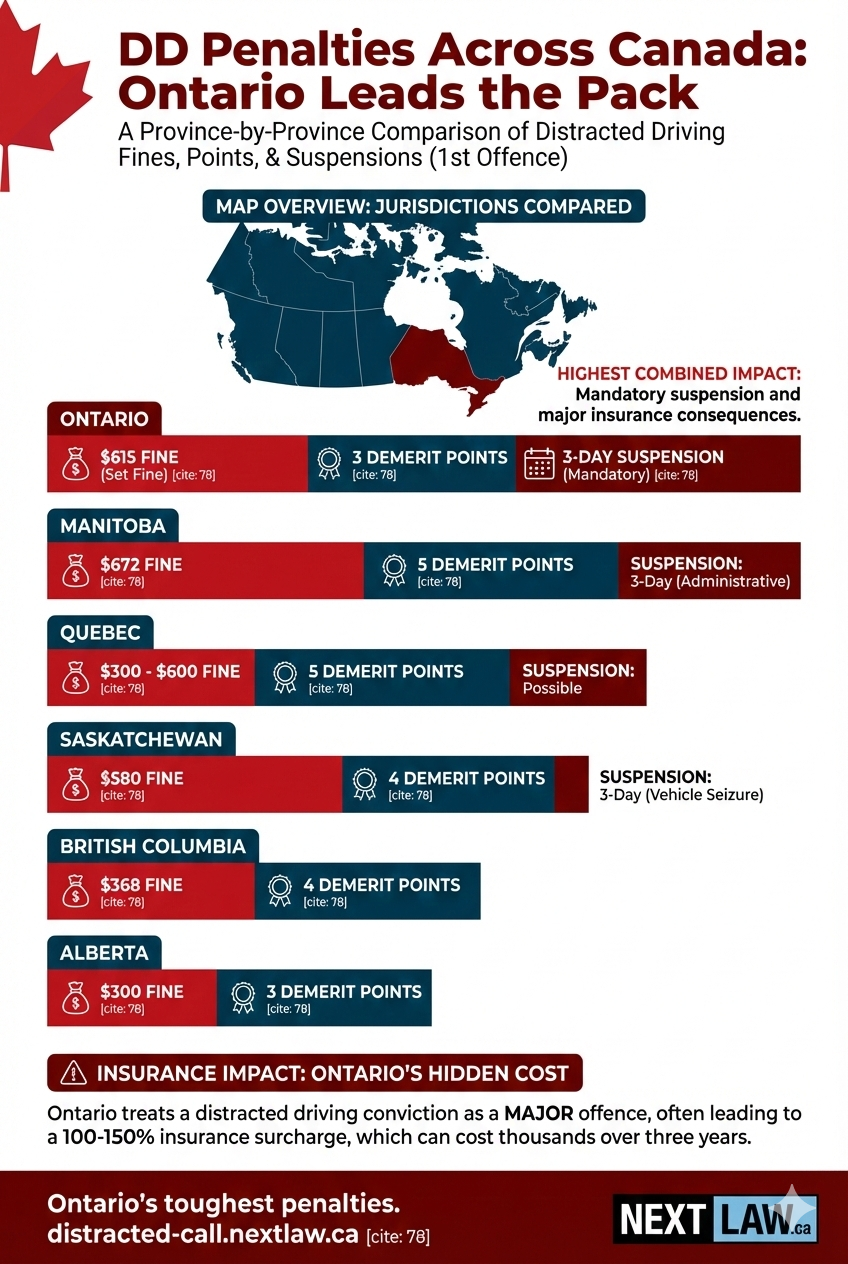
Getting pulled over for distracted driving is stressful anywhere in Canada, but the consequences vary dramatically depending on which province you're driving in. While distracted driving laws exist across the country, Ontario stands out as having some of the harshest penalties, combining hefty fines, significant demerit points, and automatic licence suspensions that can devastate your driving record and insurance rates.
In 2025 alone, Ontario recorded over 55,000 distracted driving infractions—a stunning number that reflects the province's aggressive enforcement and the frequency of this dangerous behaviour. Over the past decade, Ontario has recorded nearly 590,000 distracted driving charges, dwarfing enforcement volumes in other provinces. Combined with the highest auto insurance rates in Canada (averaging $1,920 per year), Ontario drivers face a perfect storm of legal and financial consequences for distracted driving violations.
If you're facing distracted driving charges in Ontario or anywhere across Canada, understanding how your province's penalties stack up against others is the first step toward protecting your record and minimizing the impact on your driving privileges and insurance. NextLaw can help you navigate these complex provincial differences and build an effective defence strategy. Read on to see how your province compares.
What Are the Distracted Driving Penalties in Each Canadian Province?
Quick Answer: Each Canadian province sets its own distracted driving penalties. Ontario has the highest fines (up to $3,000 in court), the most demerit points (6), and automatic licence suspensions up to 30 days. Other provinces range from fines as low as $100 (Newfoundland) to $672 (Manitoba), with demerit points ranging from 3 to 5. The comparison table below shows the full breakdown.
Canada's justice system is divided between federal and provincial powers, which means each province has the authority to set its own distracted driving penalties. While all provinces prohibit the use of handheld devices while driving, the fines, demerit points, and suspension periods vary considerably. Understanding these differences is crucial, especially if you drive across provincial borders or are planning a road trip.
Complete Canadian Provinces Distracted Driving Comparison Table
Province
Fine Range
Demerit Points
Licence Suspension
Avg. Insurance Impact/Year
Ontario
$615 (set); $500–$3,000 (court)
3–6 points (progressive)
3 days (1st); 7 days (2nd); 30 days (3rd)
+$300–$500
British Columbia
$368
4 points
None (automatic); Vehicle impound (2nd)
+$250–$400
Alberta
$300
3 points
None (automatic)
+$200–$350
Saskatchewan
$580
4 points
Potential (repeat offences)
+$150–$300
Manitoba
$672
5 points
3 days (2nd offence)
+$200–$350
Quebec
$300–$600
5 points
None (automatic)
+$100–$200
New Brunswick
$172.50–$345
3 points
None (automatic)
+$150–$250
Nova Scotia
$233.95–$578.95
4 points
None (automatic)
+$150–$280
Prince Edward Island
$500–$1,200
5 points
24-hour impound (potential)
+$250–$400
Newfoundland & Labrador
$100–$400
4 points
None (automatic)
+$150–$250
The table above reveals a critical truth: Ontario's penalties are significantly harsher than most other provinces. While Alberta and Alberta drivers pay the lowest set fines ($300), Ontario drivers face a $615 set fine that can escalate to $3,000 in court for repeat offences. More critically, Ontario is one of only four provinces with automatic licence suspension, making it one of the most driver-hostile jurisdictions in Canada for distracted driving violations.
Why Does Ontario Have the Strictest Distracted Driving Penalties?
Quick Answer: Ontario's strict distracted driving law (Highway Traffic Act Section 78.1) reflects the province's zero-tolerance approach to dangerous driving. Combined with the highest auto insurance rates in Canada and aggressive enforcement (55,000+ charges annually), Ontario drivers face the harshest consequences for mobile device use while driving.
Ontario's Highway Traffic Act, Section 78.1 was introduced in 2009 to combat the rising danger of distracted driving. Since then, the province has taken an increasingly aggressive stance on mobile device use while driving. Several factors explain why Ontario's penalties are the strictest in Canada:
High Enforcement Volume
Ontario police forces conduct more distracted driving enforcement than any other province. In 2025 alone, Ontario recorded 55,086 distracted driving infractions. This high-volume enforcement is a direct result of provincial road safety initiatives and dedicated traffic enforcement units. The sheer number of charges reflects both the prevalence of the behaviour and the province's commitment to cracking down on it.
Public Safety Priority
Ontario has made distracted driving a top public safety priority. The Ontario Ministry of Transportation has funded extensive awareness campaigns and provided police with dedicated enforcement tools. The goal is clear: deter drivers from using handheld devices by making the penalties severe and immediate.
Insurance Industry Pressure
Ontario has the highest auto insurance rates in Canada, averaging $1,920 per year. This gives insurers and the government strong financial incentives to reduce claims caused by distracted driving. Stricter penalties and higher fines translate to fewer accidents, lower insurance payouts, and stronger leverage for rate negotiations.
Cumulative Impact on Driving Record
Ontario's demerit point system compounds the problem. A distracted driving conviction adds 3 to 6 demerit points depending on the offence number. Accumulate 15 points within two years, and your licence is automatically suspended. This creates a cascading effect where a single distracted driving ticket can lead to suspension and loss of driving privileges.
How Does Ontario's Distracted Driving Penalty Compare to Other Key Provinces?
Quick Answer: Ontario's penalties are 2–6 times higher than most other provinces for fines alone. When combined with automatic suspension and demerit points, Ontario stands apart. Here's how Ontario compares to three major provinces: British Columbia, Alberta, and Quebec.
Ontario vs. Alberta
Alberta has one of the lowest distracted driving penalties in Canada. An Alberta distracted driving conviction carries a $300 fine and 3 demerit points—less than half Ontario's $615 set fine and fewer demerit points. Crucially, Alberta does not impose automatic licence suspension for a first distracted driving offence. This makes Alberta significantly more lenient than Ontario, though drivers should note that repeat offences can still trigger suspensions.
Ontario vs. British Columbia
British Columbia's fine ($368) is lower than Ontario's set fine ($615), and BC drivers receive 4 demerit points versus Ontario's 3–6. However, BC has a unique twist: repeat offences within three years can result in vehicle impoundment. While BC doesn't impose automatic licence suspension, vehicle impound is a severe consequence. Ontario's progressive suspension system (3 days, then 7 days, then 30 days) is arguably more disruptive to daily life than BC's penalty structure.
Ontario vs. Quebec
Quebec offers the most lenient penalties of the major provinces. Fines range from $300–$600, and drivers receive 5 demerit points. More significantly, Quebec does not impose automatic licence suspension, allowing drivers to retain their driving privileges even after conviction. Quebec's approach reflects the province's reliance on public auto insurance (SAAQ), which has kept insurance rates extraordinarily low at approximately $717 per year—less than one-third of Ontario's rates.
What Is the Insurance Impact of a Distracted Driving Conviction Across Canada?
Quick Answer: A distracted driving conviction increases your auto insurance premiums across Canada by $150–$500 annually, depending on your province and insurer. Ontario drivers see the largest absolute increase because Ontario has the highest baseline insurance rates in the country at $1,920/year.
Insurance Alert: A single distracted driving conviction can increase your insurance premiums by 20–50% for 3–5 years. In Ontario, this could mean paying an additional $300–$500 every year—totalling $1,500–$2,500 over a five-year period.
Insurance companies classify distracted driving as a serious traffic violation, not just a minor infraction. When you apply for insurance after a conviction, insurers recalculate your risk profile and adjust your premiums accordingly. Here's how the insurance impact breaks down by province:
Ontario Insurance Premiums
Ontario drivers already pay the highest auto insurance rates in Canada at approximately $1,920 per year. A distracted driving conviction adds $300–$500 annually, pushing some drivers to pay nearly $2,400 per year. For a driver who was previously paying $1,600/year, a conviction could mean a 30% rate increase. Over five years, that's an additional $1,500–$2,500 in insurance costs on top of the original fine.
Alberta and Saskatchewan Insurance Premiums
Alberta drivers enjoy more affordable baseline insurance at approximately $1,650/year. A distracted driving conviction adds $200–$350 annually. Saskatchewan rates are slightly lower, with additional premiums of $150–$300 per year. While the percentage increase is similar to Ontario's, the absolute dollar amount is lower because baseline rates are lower.
British Columbia Insurance Premiums
BC drivers pay approximately $1,832/year for auto insurance due to ICBC (Insurance Corporation of BC) monopoly pricing. A distracted driving conviction triggers ICBC's driver risk premium, adding $250–$400 annually. BC insurers are particularly strict with distracted driving violations because handheld device use is considered extremely dangerous.
Quebec Insurance Premiums
Quebec has the lowest auto insurance rates in Canada at approximately $717/year, thanks to public auto insurance through SAAQ. A distracted driving conviction adds only $100–$200 annually. This means a Quebec driver pays significantly less for a distracted driving conviction than an Ontario driver—potentially $200–$300 less per year.
Atlantic Provinces Insurance Premiums
Nova Scotia, New Brunswick, PEI, and Newfoundland have moderate insurance rates ranging from $1,200–$1,600 per year. Distracted driving convictions typically add $150–$400 annually to premiums. The variation depends on the insurer and whether the province has automatic licence suspension (which increases risk assessment).
Where Is Distracted Driving Most Heavily Enforced in Ontario?
Quick Answer: Toronto accounts for 37% of all distracted driving charges in Ontario, with 99,346 charges over the past decade. York Region, Ottawa, and surrounding regions see high enforcement rates due to traffic volume and dedicated OPP enforcement efforts.
Within Ontario, enforcement varies dramatically by region. Some jurisdictions prioritize distracted driving enforcement more aggressively than others, which means your risk of receiving a charge depends partly on where you're driving.
Top Enforcement Jurisdictions in Ontario (10-Year Data)
Jurisdiction
Total Charges (2016–2025)
Percentage of Ontario Total
Average Per Year
Toronto Police Service
99,346
16.8%
9,935
Provincial (OPP)
266,161
45.1%
26,616
York Region Police
25,656
4.3%
2,566
Ottawa Police Service
14,975
2.5%
1,498
Other Services (Combined)
184,267
31.2%
18,427
The Ontario Provincial Police (OPP) conduct the most distracted driving enforcement across Ontario, accounting for 45% of all charges. This reflects the OPP's highway enforcement mandate and their focus on dangerous driving. Toronto Police and York Region Police are the next highest, reflecting high population density and traffic volume in the Greater Toronto Area.
How Do Demerit Points Work in Ontario and Across Canada?
Quick Answer: Demerit points are added to your driving record for traffic violations. In Ontario, distracted driving adds 3–6 points depending on whether it's a first, second, or repeat offence. Once you accumulate 15 points within two years, your licence is automatically suspended for 30 days. Demerit points remain on your record for two years from the conviction date.
Demerit points are a critical part of Ontario's traffic enforcement system. Unlike fines, which are one-time payments, demerit points accumulate on your driving record and have long-term consequences.
Ontario's Distracted Driving Demerit Points
- First Offence: 3 demerit points
- Second Offence (within a specified period): 6 demerit points
- Third or Subsequent Offence: 6 demerit points
Licence Suspension Threshold
Ontario's demerit system is progressive. You don't face licence suspension until you accumulate 15 points within two years. However, a single distracted driving conviction can put you 40% of the way to suspension (if it's your second or subsequent offence). If you have any other traffic violations on your record, a distracted driving conviction could push you over the threshold and trigger automatic suspension.
Duration of Demerit Points
Demerit points remain on your record for exactly two years from the date of conviction. After two years, they are automatically removed. However, if you receive another conviction within those two years, the new points are added to the existing total, and the clock restarts.
Other Provinces' Demerit Points
Most provinces use similar demerit systems, though the accumulation thresholds vary. Alberta uses 12 points as the suspension threshold, while BC uses a Driver Penalty Point (DPP) system. Quebec also uses a demerit point system, with suspension at 15 points. The key difference is that Ontario's automatic suspension system is one of the most aggressive in Canada.
Are Penalties Different for Novice and G2 Drivers in Ontario?
Quick Answer: Yes. Ontario's novice driver penalties for distracted driving are significantly harsher than for fully licensed drivers. Novice drivers (G1 and G2) receive automatic 30-day licence suspension for a first offence, 90-day suspension for a second offence, and complete licence cancellation for a third offence.
Ontario's graduated licensing system (G1, G2, full G license) creates different penalty structures for distracted driving. Novice drivers face much stricter consequences than fully licensed drivers.
Novice Driver Distracted Driving Penalties (Ontario)
- First Offence (G1 or G2): 30-day licence suspension
- Second Offence (G1 or G2): 90-day licence suspension
- Third Offence (G1 or G2): Licence cancellation (must restart graduated licensing)
For a novice driver, a single distracted driving charge is catastrophic. Rather than a simple 3-day suspension like a fully licensed driver, a novice faces 30 days of losing driving privileges. This can derail school attendance, employment, and independence. A second offence extends the suspension to 90 days, effectively removing the driver from the road for three months.
Why the Harsh Penalties for Novice Drivers?
Ontario's government recognizes that novice drivers lack experience and are at higher risk for serious crashes. Distracted driving compounds this risk. By imposing harsh penalties on novice drivers, the province aims to teach the behaviour before dangerous habits form. However, this also means that a single mistake—one text message or phone call—can devastate a young driver's mobility and opportunities.
What Happens When Your Ontario Licence Is Suspended for Distracted Driving?
Quick Answer: Driving while suspended is a serious criminal offence with penalties including jail time. During your suspension, you cannot legally drive any motor vehicle in Ontario. You must surrender your licence and cannot apply for reinstatement until the suspension period ends. Reinstatement requires payment of a $250 reinstatement fee.
Licence suspension is one of the most immediate and disruptive consequences of a distracted driving conviction. Unlike fines, which you can pay over time, suspension takes effect immediately and removes your driving privileges for the duration.
Ontario Suspension Timelines for Distracted Driving
- First Offence: 3-day suspension (automatically imposed)
- Second Offence: 7-day suspension (automatically imposed)
- Third or Subsequent Offence: 30-day suspension (automatically imposed)
Consequences of Driving While Suspended
Driving while your licence is suspended is a criminal offence in Ontario. Penalties include fines up to $5,000, imprisonment up to six months, and additional licence suspension. A conviction for driving while suspended also adds to your criminal record, which can affect employment, travel, and future legal proceedings.
Reinstatement Process
Once your suspension period expires, you must apply for licence reinstatement through ServiceOntario or the DriveTest Centre. You must pay a $250 reinstatement fee. Reinstated drivers are subject to increased monitoring and are at risk of re-suspension if they receive another serious traffic violation within three years.
Where Will My Ontario Distracted Driving Case Be Heard?
Quick Answer: Your case will be heard at the Provincial Court located in your enforcement jurisdiction. If you were charged in Toronto, your case will be heard at Old City Hall. If charged in Brampton, your case will be heard in Brampton Provincial Court. See the list below for major court locations across Ontario.
Distracted driving charges in Ontario are prosecuted in Provincial Court. The specific courthouse where your case is heard depends on where you were charged. Most cases go through the provincially appointed prosecutor's office, though you have the right to representation.
Major Distracted Driving Court Locations in Ontario
Toronto Provincial Court
Old City Hall, 60 Queen Street West
Toronto, ON M5H 2R1
Phone: (416) 325-6500
Serves: Toronto, surrounding GTA areas
Brampton Provincial Court
7755 Hurontario Street
Brampton, ON L6Y 4L8
Phone: (905) 456-4700
Serves: Brampton, Caledon, parts of Peel Region
Ottawa Provincial Court
161 Elgin Street
Ottawa, ON K1A 0B2
Phone: (613) 239-1100
Serves: Ottawa and surrounding Eastern Ontario
Barrie Provincial Court
75 Mulcaster Street
Barrie, ON L4M 6K2
Phone: (705) 726-6200
Serves: Barrie, Simcoe County, and surrounding areas
Windsor Provincial Court
245 Windsor Avenue
Windsor, ON N9A 1J6
Phone: (519) 255-6700
Serves: Windsor, Essex County, and Southwestern Ontario
Sudbury Provincial Court
155 Elm Street
Sudbury, ON P3C 1T9
Phone: (705) 671-3000
Serves: Sudbury, Northern Ontario mining regions
If you've been charged with distracted driving in Ontario, your first step is to appear in the provincial court with jurisdiction over your charge. You have the right to be represented by a lawyer. NextLaw can represent you at any of these courthouses.
What Does the Data Show About Distracted Driving in Ontario?
Quick Answer: Ontario recorded 590,000+ distracted driving charges over the past decade (2016–2025), with charges increasing significantly in 2024 and 2025. Toronto and the OPP account for the majority of enforcement. The data shows aggressive provincial enforcement priorities around distracted driving.
Data tells the story of Ontario's distracted driving enforcement intensity. Over the past decade, enforcement has fluctuated based on police initiatives, public awareness campaigns, and statutory changes. However, 2025 data shows an alarming upward trend. https://www.nextlaw.ca/?p=33990
Comments
Post a Comment